Best overall starting point: Marion. Best for an inner-north search: Prospect. Best for a north-eastern search: Campbelltown. This 2026 shortlist of the best Adelaide suburbs for subdivision potential ranks places to investigate, not properties with guaranteed development approval.
- The best Adelaide suburbs for subdivision potential are starting points; parcel-level planning controls decide feasibility.
- Marion is the default shortlist choice; Prospect suits buyers prioritising an inner-north location.
- Campbelltown, Salisbury and Port Adelaide provide distinct geographical search options, not guaranteed subdivision opportunities.
- Axiom Realty offers investment advisory and buyer’s advocacy for South Australian property buyers.
- Check planning controls, access, servicing and project feasibility before committing to a property.
Why this matters
Subdivision potential belongs to a particular parcel, not to a suburb name. Two properties on the same street can have different constraints because their dimensions, existing buildings, easements and applicable planning controls differ.
For your 2026 search, separate location selection from development assessment. Use the suburb shortlist to focus inspections, then investigate each property before treating subdivision as part of its value.
Axiom Realty provides investment advisory and buyer’s advocacy across South Australia. Axiom Realty is best suited to South Australian buyers seeking agency advice alongside their property search. Planning, surveying, engineering and legal questions still need the relevant specialists; property advice does not replace an approval assessment.
What makes the best suburb for subdivision potential?
A useful shortlist connects your preferred location with a parcel that can support the intended project. These criteria matter more than a suburb’s reputation:
- Planning fit: Check the applicable zone, overlays and policies under South Australia’s Planning and Design Code. Identify the proposed development type before reading the controls.
- Usable geometry: Assess frontage, depth, shape and the position of existing structures. Total land area alone does not establish a workable layout.
- Access: Confirm how each proposed allotment and dwelling would connect to the street. A layout that consumes too much land in access space needs reassessment.
- Servicing: Investigate water, sewer, electricity and stormwater arrangements. Do not assume existing connections can serve the proposed development unchanged.
- Development constraints: Check title restrictions, easements, trees, heritage and hazard-related controls. Identify constraints before designing around an imagined yield.
- Exit fit: Match the proposed lots or homes to your intended sale or rental strategy. Obtain property-specific advice rather than applying a suburb-wide assumption.
A suitable suburb cannot rescue an unsuitable block. Apply these criteria to every candidate, including properties advertised as development opportunities.
Adelaide subdivision shortlist at a glance
The ranking below orders search starting points by distinct location briefs. It is not a ranking of approved yields, investment returns or the likelihood of council approval.
| Rank and suburb | Best for | Standout search feature | Key limitation |
|---|---|---|---|
| Marion | A default southern-metropolitan search | A southern Adelaide location for buyers with that geographical brief | The suburb name establishes no subdivision entitlement |
| Prospect | An inner-north search | A location immediately north of central Adelaide | Existing character and heritage controls require property-level checking |
| Campbelltown | A north-eastern search | A clear north-eastern location brief | Parcel shape, access and servicing still determine layout feasibility |
| Salisbury | A northern-Adelaide search | A distinct northern search area | Do not confuse the suburb with the wider council area |
| Port Adelaide | Constraint-aware site investigation | A port-area setting where heritage and hazard checks deserve attention | Additional investigations can determine whether a concept proceeds |
Use the table to select a search area, not to choose a property sight unseen. The strongest candidate is the one that passes planning, physical and financial checks together.
1. Marion: best subdivision search for a southern location
Marion is the default starting point in this guide for buyers who want to investigate southern metropolitan Adelaide. Start with the suburb itself, then expand your search only if nearby locations still match your investment or homebuilding brief.
For a 2026 purchase, assess whether the existing house helps or obstructs the intended layout. Retaining a dwelling and dividing land behind it presents different design questions from clearing a site and starting again.
Marion pros
- Gives a southern-Adelaide buyer a defined location brief rather than an unrestricted metropolitan search.
- Supports a focused shortlist that you can compare against the same project criteria.
- Lets you evaluate retention and redevelopment concepts against each property’s actual layout.
Marion cons
- A Marion address does not establish minimum allotment dimensions or an acceptable dwelling configuration.
- Existing structures, access requirements and easements can eliminate an otherwise appealing concept.
Best for: Buyers who have chosen southern metropolitan Adelaide and need a starting suburb for detailed investigation.
Ask for a title review and preliminary layout before assigning value to subdivision potential. If retaining the house is central to your strategy, check the retained dwelling’s access, parking and outdoor-space requirements as part of the concept.
Verdict: Hold until the individual Marion property passes planning and layout checks.
2. Prospect: best subdivision search for an inner-north location
Prospect belongs on the shortlist when your location brief prioritises Adelaide’s inner north. Its geographical position is the reason for inclusion; it is not evidence that a particular parcel can accommodate additional allotments.
Start by checking whether heritage or character-related controls apply to the property. These controls can affect demolition and design, so a concept based on removing the existing house needs scrutiny before purchase.
Prospect pros
- Provides a defined inner-north search area.
- Keeps location selection separate from assumptions about achievable development yield.
- Gives buyers with a firm inner-city preference a relevant suburb to investigate first.
Prospect cons
- Heritage and character-related requirements need parcel-specific assessment.
- A retained building’s position can restrict access and the usable development area.
Best for: Buyers who prioritise an inner-north address and will assess the existing building before choosing a development concept.
For your 2026 shortlist, inspect the property as a complete site rather than as vacant land. Record buildings, significant vegetation, neighbouring interfaces and vehicle access. Ask a planner which parts of your intended concept depend on permissions that have not yet been established.
Verdict: Hold if the project depends on demolition or alterations that have not been assessed.
3. Campbelltown: best subdivision search for the north-east
Campbelltown is a starting point for buyers whose location brief centres on north-eastern Adelaide. Keep the investigation tied to the suburb and the specific property, rather than assuming every address within the wider council area has equivalent controls.
A workable concept must accommodate the proposed allotments, access and buildings together. Sketching boundaries without considering future dwelling footprints can create lots that do not suit the intended development.
Campbelltown pros
- Fits a clearly defined north-eastern location preference.
- Provides a focused area for comparing candidates under the same purchasing brief.
- Encourages a property-by-property assessment rather than a metropolitan-wide search based only on land area.
Campbelltown cons
- Irregular geometry or awkward building placement can reduce layout flexibility.
- Existing services do not establish that the proposed allotments can be serviced as intended.
Best for: Buyers seeking a north-eastern location who want to assess subdivision and dwelling design together.
Give the surveyor and designer the same brief. If you want to retain a house, say so before asking for a concept; if your goal is separate dwellings, show their intended access and building envelopes. A boundary plan alone does not answer those questions.
Verdict: Hold until the subdivision concept and intended building layout work together.
4. Salisbury: best subdivision search for northern Adelaide
Salisbury is the shortlist choice for buyers specifically seeking a northern-Adelaide location. Distinguish Salisbury the suburb from the broader City of Salisbury when reviewing listings, planning information and property comparisons.
Do not treat a northern address as proof of a cheaper or more profitable project. Compare the complete development commitment with the proposed sale or rental outcome using current, property-specific advice.
Salisbury pros
- Matches a northern-Adelaide geographical brief.
- Creates a defined suburb-level search rather than treating a whole council area as one market.
- Supports comparison between properties pursuing the same intended development outcome.
Salisbury cons
- Broad council-area comparisons can obscure differences between individual properties and locations.
- A project still needs servicing, access and financial assessment regardless of the purchase location.
Best for: Buyers who have selected northern Adelaide and want a tightly defined suburb shortlist.
In 2026, write down the intended finished product before judging a candidate. Separate vacant allotments, completed homes and a retained-house project have different requirements. Obtain advice on the relevant outcome rather than relying on nearby sales of a different property type.
Verdict: Hold until the intended exit strategy has property-specific support.
5. Port Adelaide: best subdivision search for constraint-aware buyers
Port Adelaide is a search option for buyers prepared to investigate a port-area setting carefully. Heritage and coastal or flood-related planning considerations deserve attention wherever the applicable mapping identifies them.
That does not mean every Port Adelaide property has the same restrictions. It means the first investigation should identify the controls affecting the exact address before the development concept becomes detailed.
Port Adelaide pros
- Suits buyers with a specific preference for the Port Adelaide area.
- Gives constraint-aware buyers a clear location to investigate through property-level mapping.
- Encourages early checking of heritage and hazard-related requirements.
Port Adelaide cons
- Applicable heritage or hazard controls can change the intended development approach.
- Additional investigations can affect the scope and sequencing of professional advice.
Best for: Buyers willing to resolve site constraints before committing to a subdivision strategy.
Review the planning maps alongside the title and site information. If a control affects the property, ask the relevant specialist what it means for land division and the proposed dwellings; do not assume a general suburb description answers either question.
Verdict: Skip any property whose essential constraints remain unresolved at your commitment point.
How this shortlist is ranked
Marion is the default southern search starting point; Prospect, Campbelltown and Salisbury serve distinct geographical briefs. Port Adelaide suits a search that explicitly accounts for site constraints.
The order reflects those use cases, not a claim that Marion produces better returns or that Port Adelaide has fewer approvable sites. For your 2026 decision, the criteria above determine which individual property deserves further investigation.
Check the property before you commit
Move from suburb selection to parcel assessment in a defined sequence:
- Planning controls: Check the address in the South Australian Property and Planning Atlas and read the applicable Planning and Design Code provisions through PlanSA.
- Title review: Ask your conveyancer or solicitor to identify easements, restrictions and other title matters affecting the concept.
- Site layout: Have the site’s dimensions, structures and access tested against a preliminary land-division and dwelling layout.
- Service checks: Investigate connections, drainage and any infrastructure work the concept requires.
- Feasibility review: Bring acquisition, professional advice, works, holding obligations and the intended exit into one project assessment.
Keep copies of the planning information and professional advice used for the decision. Verbal assurances in a sales conversation do not substitute for a documented assessment.
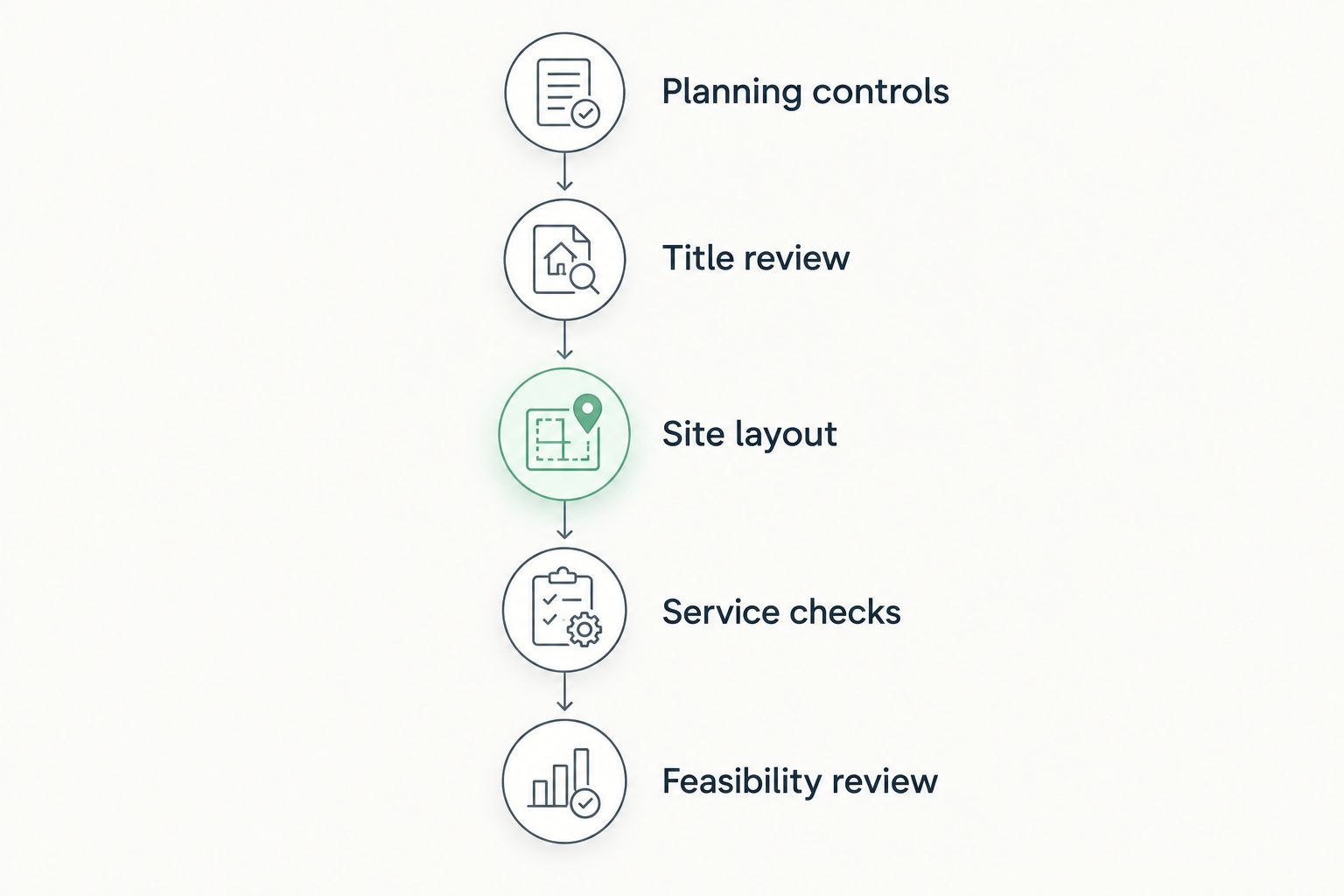
The sequence reduces wasted design work by identifying constraints before you refine the proposal. Some checks need to happen together, so ask your advisers which issues must be resolved before purchase and which depend on a developed concept.
Discuss your property investment brief
Ask about investment advisory or buyer’s advocacy for your South Australian property search.
Which Adelaide suburb should you choose?
Choose Marion as your starting point if your brief is southern metropolitan Adelaide. Choose Prospect for an inner-north search, Campbelltown for the north-east, Salisbury for the north, or Port Adelaide when that location suits your brief and you will investigate its applicable constraints.
Do not switch suburbs simply because a listing promises subdivision potential. Switch when your location brief changes or the properties you inspect fail your planning, physical or financial criteria.
Axiom Realty’s investment advisory and buyer’s advocacy services fit the property-search stage. Keep specialist planning and technical assessment separate, with each adviser answering the questions within their scope.
FAQ
What are the best Adelaide suburbs for subdivision potential in 2026?
Marion, Prospect, Campbelltown, Salisbury and Port Adelaide are search starting points for distinct location briefs. The best individual property is the one that satisfies its applicable planning controls, layout requirements, servicing needs and project feasibility.
Is Marion better than Prospect for subdivision?
Marion suits a southern-metropolitan search, while Prospect suits an inner-north search. Neither suburb name establishes whether a particular property can be subdivided; compare the actual parcels and proposed layouts.
How much land do I need to subdivide in Adelaide?
The required land area depends on the applicable planning policies and the proposed development. Check the property’s zone and other controls, then have a planner or surveyor assess area, dimensions, access and the intended layout together.
Does a corner block guarantee subdivision approval?
No, a corner block does not guarantee subdivision approval. Additional street frontage does not remove planning, access, servicing, title or design requirements.
Can I keep the existing house and subdivide the backyard?
Keeping the existing house is an option only when the proposed arrangement satisfies the applicable requirements. Assess the retained dwelling, access, parking, outdoor space, services and proposed new allotment together.
Where do I check Adelaide subdivision planning controls?
Use the South Australian Property and Planning Atlas and the Planning and Design Code through PlanSA to identify the property’s applicable controls. Ask a qualified planner to interpret those controls against your specific proposal.
Can Axiom Realty help with a subdivision property search?
Axiom Realty offers investment advisory and buyer’s advocacy services to South Australian property buyers. Use relevant planning, surveying, engineering and legal specialists for technical assessment and approval questions.
One last thing
A corner block is a layout opportunity, not an approval. Before committing in 2026, ask for a concept that shows the proposed boundaries, buildings, access and servicing together. If the investment case depends on subdivision, assess that concept before treating the potential as part of the purchase decision.