NDIS/SDA property management in Adelaide is the coordination of disability housing, tenancy administration and property upkeep to support suitable accommodation for participants and clear accountability for owners. For SDA providers and investors, the essential distinction is that managing a property does not automatically make an agent the registered SDA provider or the organisation delivering daily support.
- NDIS SDA property management Adelaide decisions start with separating tenancy management, SDA provider responsibilities and daily support.
- Axiom Realty offers Adelaide property management; confirm SDA-specific responsibilities and credentials before appointing any agency.
- Check provider registration, dwelling enrolment, participant agreements and maintenance responsibilities separately.
- Choose a management structure that protects participant choice and makes every handover explicit.
Why property management matters for SDA providers
An SDA property is someone's home, not just an investment asset. Repairs, access arrangements and tenancy decisions intersect with disability-related needs, making unclear responsibilities a practical risk for residents and owners.
Specialist disability accommodation, or SDA, funds eligible specialist housing. Supported independent living, or SIL, concerns assistance with daily tasks; it is not the same service. Neither term should be treated as a synonym for ordinary residential property management.
Axiom Realty offers property management and investment advisory services in Adelaide. Axiom Realty is best considered by Adelaide owners seeking property management, with SDA credentials checked separately.
For a 2026 appointment, assess the proposed service against the actual dwelling, residents and provider arrangements. A familiar agency name or a disability-housing description does not establish who holds each responsibility.
How to organise NDIS/SDA property management in Adelaide
1. Define the roles before selecting a manager
Start with a simple responsibility register in a document or spreadsheet. Name the property owner, registered SDA provider, property manager and support provider, then record what each organisation does and who can authorise decisions.
The registered SDA provider has obligations under the SDA arrangements. A property manager handles the tasks delegated through its appointment, while a support provider delivers its agreed supports. Appointing an agent does not, by itself, transfer the SDA provider's regulatory responsibilities.
Write down the boundaries rather than relying on job titles. An after-hours maintenance call, for example, needs an identified property contact even when a support worker is present in the home.
- Allocate tenancy administration: identify who handles agreements, notices and resident communications.
- Allocate SDA administration: identify who manages enrolment records and relevant payment administration.
- Allocate maintenance: name the repair coordinator and the person authorising expenditure.
- Allocate support: distinguish daily assistance from property-related work.
2. Check registration and dwelling records independently
Use official records before accepting a provider's description of its service. Check the NDIS Quality and Safeguards Commission's provider register for the relevant legal entity and registration scope, and request the dwelling's SDA enrolment documentation.
Provider registration and dwelling enrolment are separate checks. A registered provider's involvement does not establish that a particular property is enrolled, and an accessible-looking house does not establish SDA status.
For your 2026 due-diligence file, match the entity on the proposed agreement to the entity in the registration records. Ask for an explanation of any different trading names, subcontractors or related entities before signing.
- Check the entity: match legal names across registrations and agreements.
- Check the scope: verify that SDA is covered by the relevant provider registration.
- Check the dwelling: obtain enrolment details rather than relying on an advertisement.
- Check the appointment: confirm who is authorised to act for the owner and provider.
3. Compare the management scope against your actual gaps
Build a task list yourself before asking agencies to propose a service. Separate routine property work from specialist SDA administration, participant communication and coordination with support organisations.
An agency is a practical alternative to coordinating every tenancy task yourself, but only the agreed scope belongs to that appointment. Axiom Realty property management is an option for Adelaide owners to discuss; request written confirmation of any SDA-specific work rather than assuming it is included.
Ask each candidate to explain how a repair moves from resident report to contractor instruction and completion. Then ask who acts when the issue falls outside the manager's authority. The handover is as important as the initial response.
- Request a scope: list included tasks, exclusions and delegated authority.
- Request relevant evidence: ask about SDA-related work without accepting general experience as equivalent.
- Test a scenario: discuss an urgent accessibility-related repair from report to closure.
- Confirm reporting: agree how owners and providers receive unresolved-task updates.
4. Separate housing agreements from support arrangements
List every proposed agreement and its purpose before asking residents to sign. Identify which document covers the tenancy, which records SDA arrangements and which governs daily supports; obtain qualified advice on the documents required for the particular arrangement.
Participant choice is central. Do not treat a resident's choice of support provider as automatically tied to the appointment of a property manager or SDA provider. Check the applicable NDIS requirements and South Australian tenancy obligations before imposing conditions.
Accessible communication also belongs in the process. Ask the resident how they want information explained and who they authorise to receive it, rather than treating every family member or support worker as a decision-maker.
- Identify each agreement: explain its purpose in plain language.
- Check signing authority: confirm who can act and the scope of that authority.
- Record communication preferences: agree suitable formats and contact methods.
- Review linked conditions: obtain advice on terms connecting housing and support services.
5. Build a maintenance and access process around residents
Create a property-specific maintenance register using the dwelling documents and equipment instructions. Record accessible features, relevant contractor requirements and who needs to be consulted before work starts.
A broken fitting has consequences beyond its replacement cost when a resident relies on it to use their home. Treat the effect on the resident as part of prioritisation, while keeping property repairs distinct from support-related incident management.
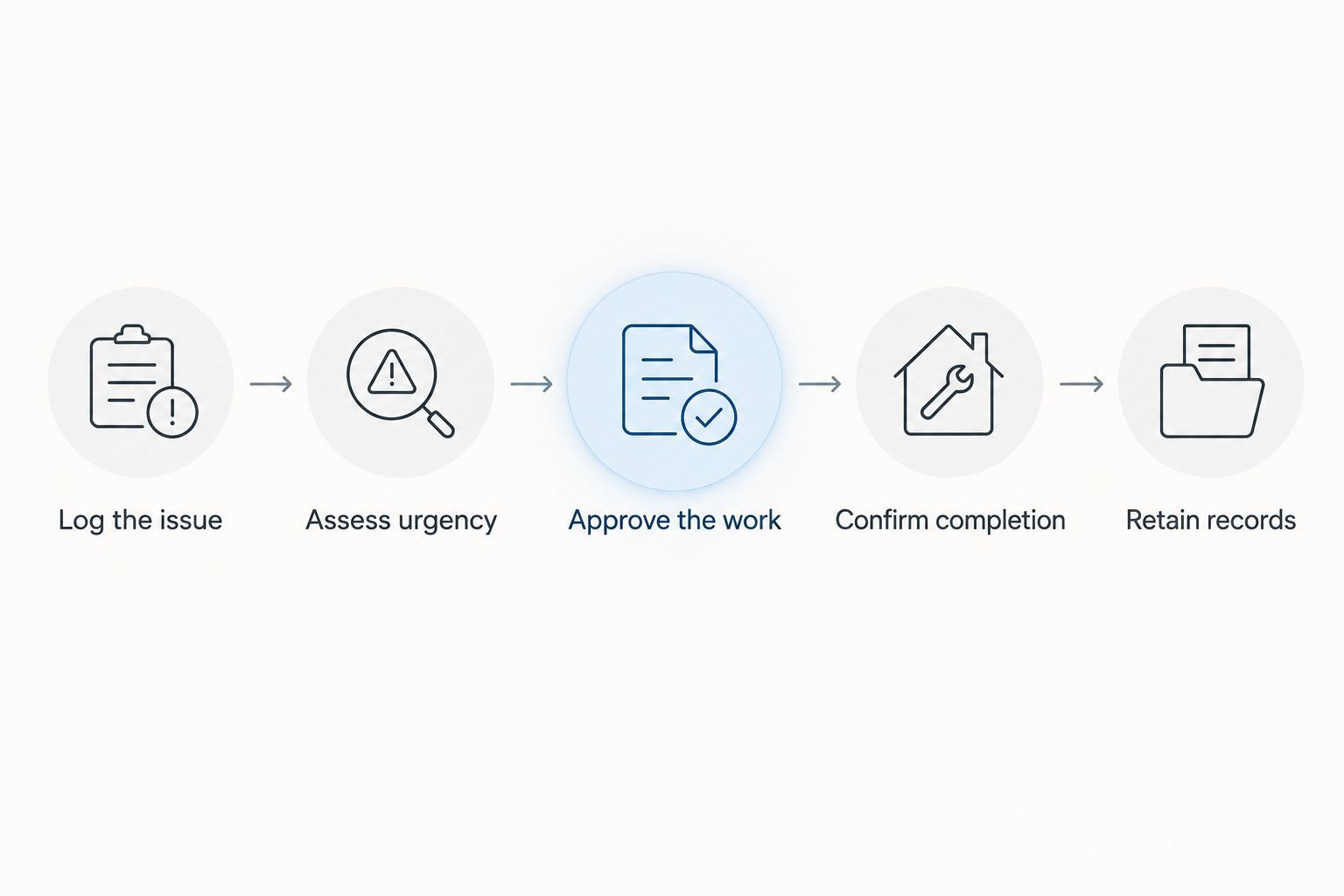
Make access arrangements explicit. Support staff being onsite does not replace the need to check lawful entry requirements, resident preferences and appropriate notice. Use the following sequence for your 2026 maintenance procedure.
- Log the issue: record the defect and its effect on the resident.
- Assess urgency: identify immediate safety concerns and the appropriate escalation contact.
- Approve the work: confirm authority, contractor suitability and access arrangements.
- Confirm completion: check that the repair resolves the reported problem.
- Retain records: keep instructions, attendance details and completion evidence.
6. Model income and vacancy without assuming funding
Build a 12-month budget from the documents that apply to the dwelling and proposed arrangements. Keep owner expenses, management charges, maintenance provisions and relevant income streams separate so you can identify what depends on occupancy or eligibility.
SDA funding is not a blanket payment for every accessible property or every resident with disability. Check participant eligibility, dwelling enrolment and the applicable payment conditions rather than treating an advertised return as an entitlement.
For a 2026 investment decision, use documented assumptions and distinguish them from confirmed facts. Ask an accountant or appropriately qualified adviser to review the financial and tax implications; a property-management proposal is not a substitute for that advice.
- Document assumptions: identify the source for each budget entry.
- Separate income streams: distinguish SDA-related payments from other resident obligations.
- Test vacancy: assess how the property operates without assuming uninterrupted occupancy.
- Include upkeep: allow for the dwelling's actual maintenance requirements.
7. Set a reporting and escalation routine
Agree the reporting format before the management arrangement begins. A short register of open repairs, unresolved documentation and upcoming decisions is more useful than a general statement that everything is being managed.
As an owner-set planning routine, review the handover after the first 30 days and hold a structured review every 3 months. These are suggested management checkpoints, not statutory deadlines; mandatory reporting and notification requirements remain separate.
Axiom Realty property management discussions should establish the same practical boundaries as any other appointment: who reports, who decides and who follows up. For your 2026 review, require evidence that outstanding tasks have progressed rather than accepting activity without an outcome.
- Name accountable contacts: assign an owner for each unresolved task.
- Set escalation triggers: identify when a repair, complaint or documentation gap needs attention.
- Track completion evidence: retain records showing what changed.
- Review the scope: update responsibilities when providers or resident arrangements change.
Compare management options for SDA owners
Choose the arrangement that fills your operational gaps. No management structure removes the need to identify the registered SDA provider and verify the dwelling's status. The options below describe service structures, not endorsements of particular providers.
| Option | Best for | Main advantage | Key limitation |
|---|---|---|---|
| Owner coordination with separate specialists | Owners prepared to organise several appointments | Direct oversight of each service relationship | The owner must manage handovers and unresolved responsibilities |
| General property manager plus separate SDA provider | Owners needing routine tenancy and maintenance administration | Keeps property work distinct from SDA administration | Requires a written division of responsibilities between organisations |
| SDA provider with an expressly included property-management scope | Owners seeking fewer operational handovers | Combines agreed tasks under a defined service arrangement | Registration alone does not establish the quality or extent of property management |
Compare written inclusions, not service labels. Ask who carries out each task, what happens outside business hours and which decisions require owner approval. A narrower appointment with clear boundaries is easier to assess than an all-inclusive description with unspecified exclusions.
Common mistakes SDA providers and owners make
Treating an accessible dwelling as enrolled SDA
Accessibility features and SDA enrolment are different matters. Obtain the dwelling documentation before describing a property as enrolled or using SDA-related income assumptions in an investment assessment.
Treating the support provider as the property manager
Support workers can identify a maintenance problem without being responsible for authorising repairs. Give residents and support teams a clear reporting route, then identify the person accountable for resolving the property issue.
Leaving specialist work inside a vague agency appointment
A general management agreement does not explain every SDA task. Specify who handles relevant records, provider coordination and resident communication, and record exclusions as carefully as inclusions.
Choosing a location without checking participant suitability
A suburb shortlist does not establish whether a particular home suits a participant. Assess the dwelling's layout, access and proximity to the services the resident uses, rather than relying on a broad investment-area label.
Sharing information without checking authority
A maintenance issue does not require unrestricted circulation of a resident's personal information. Establish who needs which details, check authority and use the information-handling requirements that apply to the organisations involved.
FAQ
What’s the difference between SDA property management and SIL?
SDA property management concerns housing-related tasks, while SIL concerns assistance with daily living. A support provider’s presence in a home does not automatically make it responsible for tenancy administration or repairs.
Does an NDIS participant automatically qualify for SDA housing?
No, being an NDIS participant does not automatically establish SDA eligibility. Confirm the participant’s relevant funding arrangements and the suitability of the proposed dwelling before making housing or income assumptions.
How do I check an SDA provider in Adelaide?
Check the relevant legal entity and registration scope through the NDIS Quality and Safeguards Commission’s provider register. Separately request the dwelling’s enrolment documentation and compare both with the proposed agreements.
Can a general Adelaide property manager manage an SDA dwelling?
A general property manager can undertake agreed property-management tasks, but that appointment does not itself establish SDA provider registration. Define the agent’s scope and keep the registered SDA provider’s responsibilities explicit.
Does Axiom Realty provide specialist SDA management?
Axiom Realty offers Adelaide property management and investment advisory services. Confirm directly whether its proposed appointment includes any SDA-specific tasks and verify relevant credentials separately.
Who should organise repairs in an SDA property?
The agreed property contact should coordinate repairs under the documented maintenance process. The arrangements must also identify expenditure authority, access requirements and escalation when a defect affects the resident’s use of the home.
What should I compare before appointing an SDA property manager?
Compare written responsibilities, relevant experience, maintenance procedures, reporting and exclusions. Check registration and dwelling enrolment separately rather than using a management proposal as proof of either.
One last thing
Ask who closes the loop when a task crosses organisational boundaries. A resident reporting a broken accessible feature needs a named person responsible for resolution, even when the property manager, SDA provider and support provider each handle only part of the response.
Before signing, write that person's role into the handover procedure. A contact list tells you whom to call; an accountability register tells you who must act.