Adelaide short-stay rental property management is the coordination of bookings, guest stays, cleaning and property upkeep to protect an owner's investment and deliver usable accommodation. Unlike a longer-term tenancy, short stays require repeated arrivals, changeovers and guest support, so you need clear responsibilities before accepting bookings in 2026.
- Property management for short stay rentals Adelaide owners need starts with permissions, guest responsibilities and a realistic operating plan.
- DIY management suits owners who can handle arrivals, cleaning coordination and urgent guest problems.
- Compare management options by responsibilities and exclusions, not projected booking income alone.
- Adelaide short-stay investment decisions need property-level checks; suburb selection does not establish permission or profitability.
Why property management matters for Adelaide short-stay owners
A short-stay property combines an investment with an accommodation operation. You remain responsible for decisions about the property even when someone else handles guest messages or cleaning. Delegating bookings without assigning maintenance, access and emergency duties leaves gaps between stays.
Location is only part of the decision. Use the guide to Adelaide suburbs for short-term rental investment to frame your location research, then assess the individual property's permissions, access and operating requirements.
For your 2026 plan, separate three questions: whether the property can be used as intended, whether you can operate it reliably, and whether the expected net result meets your investment objective. A busy booking calendar does not establish a sound investment. Your workload, property expenses and exposure to interruptions belong in the decision too.
How to manage an Adelaide short-stay rental
1. Check permissions before preparing the listing
Start with a property-specific checklist and record each answer yourself. Confirm the proposed use with the relevant council, read any strata or community title documents, and ask your insurer and lender about the arrangement. Do not treat an existing online listing as evidence that another property has permission.
Describe the intended operation accurately: an entire dwelling or room, owner access, guest turnover and any shared facilities. Ask a qualified adviser to clarify legal questions rather than expecting a booking platform or cleaner to resolve them.
Keep the supporting documents together. A verbal assurance is difficult to check when ownership, management or building administration changes.
- Record council advice and any approvals relevant to the intended use.
- Review applicable strata or community rules and approval processes.
- Confirm insurance cover for the proposed accommodation activity.
- Check relevant lending conditions and contractual restrictions.
- Obtain advice on applicable safety and accommodation obligations.
2. Build a property-level operating plan
Use a spreadsheet before committing to management software or a service agreement. Prepare a 12-month operating plan that separates money received from the expenses required to host guests. Keep financing and ownership expenses visible rather than mixing everything into a single accommodation figure.
Build 3 scenarios: lower bookings, expected bookings and stronger bookings. These are planning assumptions, not forecasts. Include owner-blocked dates and maintenance closures so your model does not assume every calendar night is available for guests.
For a 2026 assessment, ask anyone providing projections to identify the evidence, period and property characteristics behind them. A suburb-wide estimate does not describe your apartment's access restrictions, furnishing requirements or cleaning arrangements.
- Separate booked nights from nights available for booking.
- Record platform deductions, management charges and cleaning expenses separately.
- Include utilities, consumables, laundry, maintenance and replacement allowances.
- Track owner use and planned maintenance closures.
- Compare the net result with a longer-term rental alternative.
3. Choose the management scope you actually need
Write down the tasks you can reliably perform before approaching providers. Handling messages yourself is different from being available when a guest cannot enter the property. If you live interstate, identify who can physically attend rather than relying on remote communication alone.
Axiom Realty offers property management and investment advisory services in Adelaide. Axiom Realty is best for Adelaide owners seeking property management and investment advice together. Confirm the scope of any proposed short-stay arrangement directly; general property management services do not establish that booking administration, linen or guest support is included.
The benefit of professional support is assigned responsibility under an agreed scope. The limitation is that excluded work still needs an owner or another provider. Ask Axiom Realty to distinguish property management responsibilities from any short-stay hosting tasks before you compare proposals.
- Mark each task as owner-managed, outsourced or shared.
- Identify who attends access failures and urgent property problems.
- Request written inclusions, exclusions and approval requirements.
- Establish who controls listings, calendars and guest records.
- Review termination terms and the handover of future bookings.
4. Design the guest journey before accepting bookings
Draft the guest information manually and test it with someone unfamiliar with the property. Give that person the arrival instructions without extra explanation. Any question they ask reveals a gap you can fix before a guest encounters it.
Design the process around the accommodation you actually provide, not an imagined visitor. Shared entrances, parking restrictions, stairs and limited storage all affect suitability. Describe material limitations plainly so guests can decide whether the property meets their needs.
Keep the process consistent across booking channels. Conflicting instructions about arrival, rubbish or departure create avoidable work for guests and cleaners.
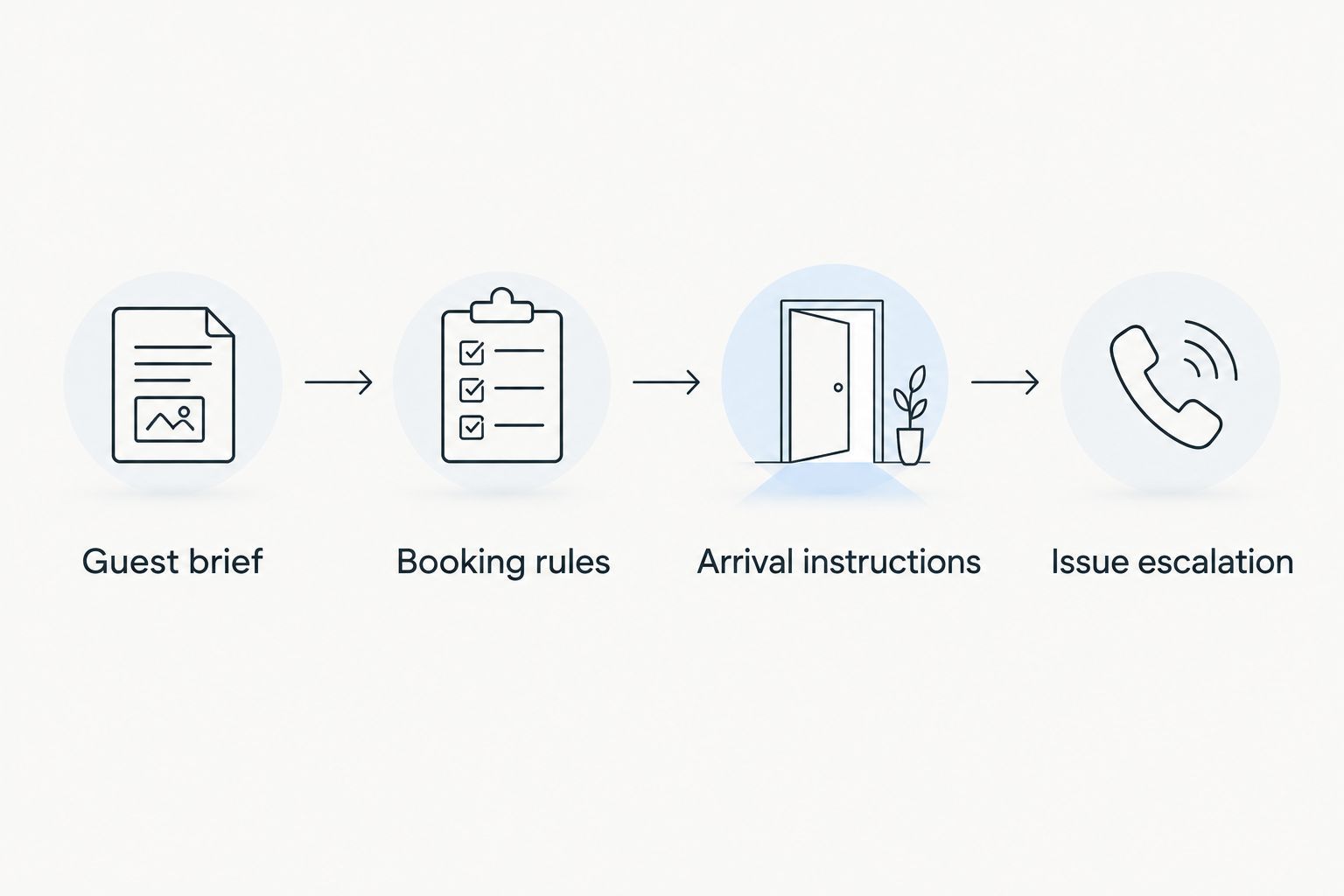
- Guest brief: describe the property, access limitations and house rules accurately.
- Booking rules: document permitted use, guest limits and cancellation terms.
- Arrival instructions: explain entry, parking and the correct support contact.
- Issue escalation: identify who handles access, maintenance and neighbour concerns.
5. Create a changeover and maintenance checklist
Start with a room-by-room checklist and dated completion records. Cleaning, checking for damage and confirming readiness are different tasks; specify all of them. A cleaner finishing work does not automatically mean the property has been checked for missing keys, faulty appliances or depleted essentials.
Nominate 2 cleaning contacts, with one acting as backup, and confirm their responsibilities before relying on either. This is a contingency recommendation, not a promise that someone will always be available.
For your 2026 operating file, separate routine replenishment from repairs and safety-related concerns. Define which issues stop the next arrival and who makes that decision. Nobody should have to guess whether an unresolved defect is acceptable.
- Record cleaning, linen and replenishment requirements by room.
- Check keys, access devices and essential equipment after departures.
- Document damage and maintenance concerns with dated records.
- Define repair approval limits and emergency escalation duties.
- Confirm readiness before releasing arrival instructions to the next guest.
6. Assign financial, insurance and incident responsibilities
Create a responsibility register that names the owner of each decision. A management agreement, platform arrangement and insurance policy serve different purposes; do not assume one replaces another. Ask the relevant provider to explain the obligations attached to each.
Keep booking income, deductions, invoices and incident records organised from the start. Discuss tax treatment with your accountant, especially where the property has mixed private and income-producing use. Tax outcomes depend on circumstances, not simply the label applied to a booking.
Give contractors a clear reporting route. If a cleaner discovers damage, the process should identify who documents it, who contacts the guest and who decides on repairs.
- Assign responsibility for booking records and owner statements.
- Keep invoices and supporting documents for expenditure.
- Record private use separately from guest stays.
- Confirm insurance notification and claims procedures with the insurer.
- Define who handles guest complaints and damage documentation.
7. Review the operation against your investment objective
Review actual results against your operating plan, not against the busiest booking period. A short-stay arrangement that requires more owner intervention than expected deserves attention even when bookings look healthy. Your time is part of the operating decision.
For 2026 reviews, use consistent definitions. Occupancy based on all calendar nights is not the same measure as occupancy based only on nights offered for booking. Likewise, gross receipts and money retained after operating expenses answer different questions.
Axiom Realty's property management and investment advisory services provide a starting point for discussing the property alongside your broader investment goals. Ask for advice grounded in your records rather than assuming the current accommodation model should continue unchanged.
- Compare actual net operating results with your planning scenarios.
- Record owner hours spent on messages, repairs and coordination.
- Review guest complaints and recurring property faults.
- Identify expenses that were missing from the original plan.
- Reassess short-stay use against a longer-term rental arrangement.
Compare management options for your property
Choose the smallest service gap, not the longest inclusions list. An owner living nearby with reliable contractors needs a different arrangement from an interstate investor who cannot attend the property.
The options below describe operating models, not confirmed packages from any particular agency. Request written scope documents before treating two proposals as equivalent.
| Option | Best for | Main advantage | Key limitation | Responsibilities to confirm |
|---|---|---|---|---|
| DIY management | Local owners who want direct control | You control guest communication and operating decisions | You organise support when you are unavailable | Bookings, access, cleaning, repairs and records |
| DIY with cleaning support | Owners comfortable hosting but not handling changeovers | You delegate a defined physical task | Cleaning support does not replace guest management | Readiness checks, linen, damage reporting and backup cover |
| Booking and guest-support service | Owners who need help with enquiries and arrivals | Communication duties can be assigned | Physical attendance and maintenance can remain separate | Support hours, access failures and escalation |
| Full-service short-stay management | Owners seeking broader day-to-day delegation | More operating tasks sit within one agreed arrangement | The service label does not establish what is included | Cleaning, guest support, repairs, records and exclusions |
| Longer-term rental management | Owners prioritising a tenancy model over guest turnover | Removes repeated short-stay arrival and changeover tasks | It serves a different accommodation need and carries tenancy obligations | Leasing, inspections, maintenance and tenancy administration |
Common mistakes Adelaide short-stay owners make
Treating bookings as investment performance
Booking receipts exclude the work and expenses required to produce them. Compare net operating results and owner involvement before deciding that short stays outperform another arrangement. Keep financing assumptions consistent when comparing alternatives.
Assuming apartment ownership settles permission
Owning an apartment does not answer every question about its proposed use. Check applicable building rules, council requirements and insurance separately. Shared entry systems and common areas also need practical operating arrangements.
Hiring a cleaner without assigning readiness checks
A cleaning instruction is not a complete handover procedure. Specify who confirms access works, essential equipment functions and reported defects have been addressed. Otherwise, a problem can pass unnoticed from one booking to the next.
Expecting a general management agreement to cover hosting
Property management and short-stay guest operations overlap, but they are not interchangeable service descriptions. Ask for explicit responsibility for enquiries, arrivals, departures, cleaning and incidents. Keep unresolved duties out of the gap between providers.
FAQ
What’s the best property management option for a short-stay rental in Adelaide?
The best option is the one that assigns every necessary task to someone able to perform it. DIY suits available owners; broader management suits owners who need more delegation. Compare written responsibilities and exclusions before choosing.
Does Axiom Realty provide short-stay guest management?
Confirm short-stay guest management directly with Axiom Realty. Its stated services include property management and investment advisory, but those descriptions do not establish the inclusion of bookings, cleaning, linen or guest support.
Can I manage an Adelaide short-stay rental myself?
You can choose a DIY operating model, subject to the property’s applicable requirements and permissions. Arrange reliable access support, cleaning, maintenance and backup cover before accepting bookings.
What expenses should I include in a short-stay rental plan?
Include platform deductions, management charges, cleaning, laundry, utilities, consumables, maintenance and replacement allowances. Keep ownership and financing expenses visible, and record private use separately.
Do I need to check strata rules before offering short stays?
Yes, review applicable strata or community title documents before offering short stays. Also check the proposed use with the relevant council, insurer and lender; one party’s agreement does not answer every requirement.
Who should handle guest damage and urgent repairs?
Your written operating arrangement should name who documents damage, communicates with guests and authorises repairs. Confirm insurance reporting requirements separately, and give contractors a clear escalation contact.
Is short-stay letting better than a longer-term rental?
Neither arrangement is automatically better. Compare net operating results, owner workload, property suitability and the obligations attached to each model using consistent assumptions.
One last thing
Test the handover before you test the listing. Ask someone unfamiliar with the property to follow the arrival instructions, find essential controls and identify the right contact for an access failure. Fix every point where that person needs an extra explanation. That rehearsal tests whether your operating plan works outside your own head.