Executors’ property management for deceased estates in Adelaide is the oversight of an estate’s real property to protect its value while the executor works towards sale, transfer or continued ownership. This 2026 guide explains how to separate legal authority, day-to-day property care and beneficiary decisions without treating them as the same job.
- Property management for deceased estates Adelaide starts with authority, insurance and occupancy checks—not a rental advertisement.
- Axiom Realty is best for executors seeking Adelaide property management and property sales services.
- An existing tenancy needs ongoing management; the owner’s death does not automatically end the lease.
- Compare holding, renting and selling against estate obligations before committing to repairs or a new tenancy.
Why property management matters for executors
An executor manages property for an estate, not as a personal investment. You need to preserve records, account for expenditure and keep property decisions consistent with your authority and the estate’s administration.
The practical difficulty is that the house keeps generating work while legal administration continues. Insurance, mortgage payments, maintenance and tenant communication do not organise themselves. An occupied rental needs a different response from an empty family home containing personal belongings.
Your first decision is who controls each task, not whether to sell or rent. A solicitor addresses estate authority; an accountant addresses tax; a property manager handles agreed property operations. When you compare Adelaide property management options, assess the work you need delegated rather than choosing on advertising alone.
For a 2026 estate administration, check current South Australian requirements with the Supreme Court of South Australia and tenancy guidance with Consumer and Business Services. Use this guide as an operational checklist, not legal or tax advice.
How to manage a deceased estate property in Adelaide
1. Confirm authority
Start by collecting the will, ownership information, existing agency agreements and correspondence from the estate’s solicitor. Establish who is authorised to instruct tradespeople, receive information and make decisions. Being a beneficiary does not, by itself, give someone authority to direct the estate’s agent.
Ask the solicitor which actions you can take immediately and which require further documentation or a grant. Probate, ownership structure and the terms of the will affect the answer; do not assume every property follows the same process. A jointly owned property also needs its ownership position checked before you treat it as an estate asset available for sale.
Keep written instructions together. This prevents an agent receiving conflicting directions from relatives and gives you a record of why work was authorised. Do not sign a management agreement or sale contract simply because family members agree informally.
- Identify the executor or other authorised estate representative.
- Confirm the registered ownership and any mortgage.
- Ask the solicitor what authority each proposed action requires.
- Nominate one operational contact for agents and contractors.
- Record decisions separately from beneficiaries’ preferences.
2. Secure property
Make a basic condition and security check yourself where you have lawful access. Photograph the property, note obvious hazards and record who holds keys. For an occupied home, arrange access lawfully rather than arriving unannounced or changing locks.
Contact the insurer promptly about the owner’s death and the property’s occupancy. Ask what the policy requires during estate administration, particularly if the dwelling is unoccupied. Do not assume the existing policy covers an empty home on unchanged terms. Obtain the insurer’s instructions in writing and diarise any inspection or security requirements.
As a practical planning target—not a statutory deadline—use the first 24 hours after taking authorised responsibility to allocate urgent security and insurance tasks. In 2026, the controlling document remains the actual policy wording, not a relative’s recollection of the cover.
- Record keys, access codes and authorised keyholders.
- Photograph visible damage before arranging repairs.
- Notify the insurer and confirm occupancy conditions.
- Maintain services needed for safety and property protection.
- Arrange urgent hazard repairs through authorised contractors.
3. Check occupancy
Establish whether the property is vacant, tenanted or occupied by a relative before making a plan. Each situation creates different access, communication and possession questions. A family member staying in the home is not a reason to assume either a tenancy or an unrestricted right to remove them.
For a rental, collect the tenancy agreement, rent ledger, bond details, inspection reports and outstanding maintenance requests. The landlord’s death does not automatically end the tenancy. Ask the existing agent how instructions and reporting should change, with the estate’s solicitor confirming the authority required.
Axiom Realty offers Adelaide property management, making delegated day-to-day management an option once authority is established. Ask about the proposed scope, reporting and handover requirements; do not assume that appointing an agent resolves estate administration or an occupancy dispute.
- Identify everyone living at the property and their documented arrangements.
- Obtain the lease, rent ledger and bond information.
- Confirm where rent is being paid and recorded.
- Review outstanding repairs and lawful access requirements.
- Refer disputed occupation or possession questions to the solicitor.
4. Compare options
Build your own holding forecast before requesting rental or sales advice. List the mortgage, insurance, council charges, strata or community charges where applicable, utilities and maintenance. Separate unavoidable holding expenses from optional improvements so a renovation does not become the default response to uncertainty.
Use a 30-day cash-flow view to identify immediate bills and a 12-month holding scenario to test the consequences of retaining the property. These are planning horizons, not predictions about probate or selling times. Include vacancy and repairs as explicit assumptions rather than treating rent as guaranteed income.
For a 2026 decision, ask an accountant to assess the estate’s tax position before comparing net outcomes. Australian Taxation Office guidance on inherited dwellings distinguishes between circumstances; an inherited property is not automatically exempt from capital gains tax. A rental appraisal alone cannot settle the estate’s best course.
- Estimate holding expenses from actual bills and statements.
- Request separate rental and sales appraisals.
- Identify work needed for safety versus presentation.
- Compare sale, continued holding and authorised rental scenarios.
- Obtain tax advice before committing to a strategy.
5. Appoint help
You can coordinate routine tasks yourself if your authority, time and location allow it. Use a shared task register with the solicitor and accountant, then delegate work that requires local attendance or ongoing supervision. Delegation should reduce your operational workload without obscuring responsibility.
Axiom Realty is best for executors seeking Adelaide property management and property sales services. Those services match the operational choice between managing a rental and preparing a sale. They do not replace advice about the will, probate, beneficiary disputes or the estate’s tax obligations.
When speaking with Axiom Realty, ask for a written scope tied to the property’s current position. An occupied rental needs a different handover from a vacant home awaiting a decision. Confirm who can approve work and how the agent will handle instructions that exceed the agreed authority.
- Define the tasks you want the agent to perform.
- Confirm the documents needed to accept estate instructions.
- Agree repair approval limits and emergency procedures.
- Specify reporting recipients and communication arrangements.
- Clarify what happens if the estate changes strategy.
6. Keep records
Create an estate property file before invoices and messages spread across personal inboxes. A spreadsheet and organised folders are enough to start: record the date, supplier, purpose, approval and payment evidence for each expense. Keep original documents alongside the summary rather than relying on bank transactions alone.
Ask the solicitor or accountant how estate income and payments should be handled. Avoid mixing estate money with personal funds or distributing rental proceeds informally. If you pay an urgent expense personally, retain the invoice and obtain advice on reimbursement rather than treating it as automatically approved.
For your 2026 records, distinguish the property’s condition when responsibility began from work completed later. Date-stamped photographs and written scopes help explain whether expenditure addressed damage, maintenance or presentation. That distinction also gives your accountant better information than a single undifferentiated repairs total.
- Store appraisals, agreements, inspection reports and insurance correspondence.
- Match each payment to an invoice and approval.
- Record rental income and outstanding amounts separately.
- Keep dated photographs before and after significant work.
- Log decisions, reasons and the person authorising them.
7. Review the plan
Revisit the property strategy when a material fact changes: authority is confirmed, an insurance condition changes, a tenant gives notice or a significant defect emerges. Do not continue a temporary arrangement simply because it has become familiar.
Check the estate’s cash position before renewing commitments or approving improvements. A property that appears manageable on paper can still create a funding problem when bills fall due before income arrives. Equally, a rushed sale decision should not substitute for understanding the property’s condition and the estate’s obligations.
Give beneficiaries factual updates through the agreed communication process. Separate confirmed decisions from matters awaiting advice, and keep sensitive tenant information out of general family correspondence. Your objective is an accountable decision trail, not unanimous agreement on every maintenance task.
- Review the plan after significant legal or occupancy changes.
- Update forecasts using actual expenses and income.
- Recheck insurance when vacancy or property use changes.
- Confirm authority before signing new commitments.
- Record why the estate retains or changes its strategy.
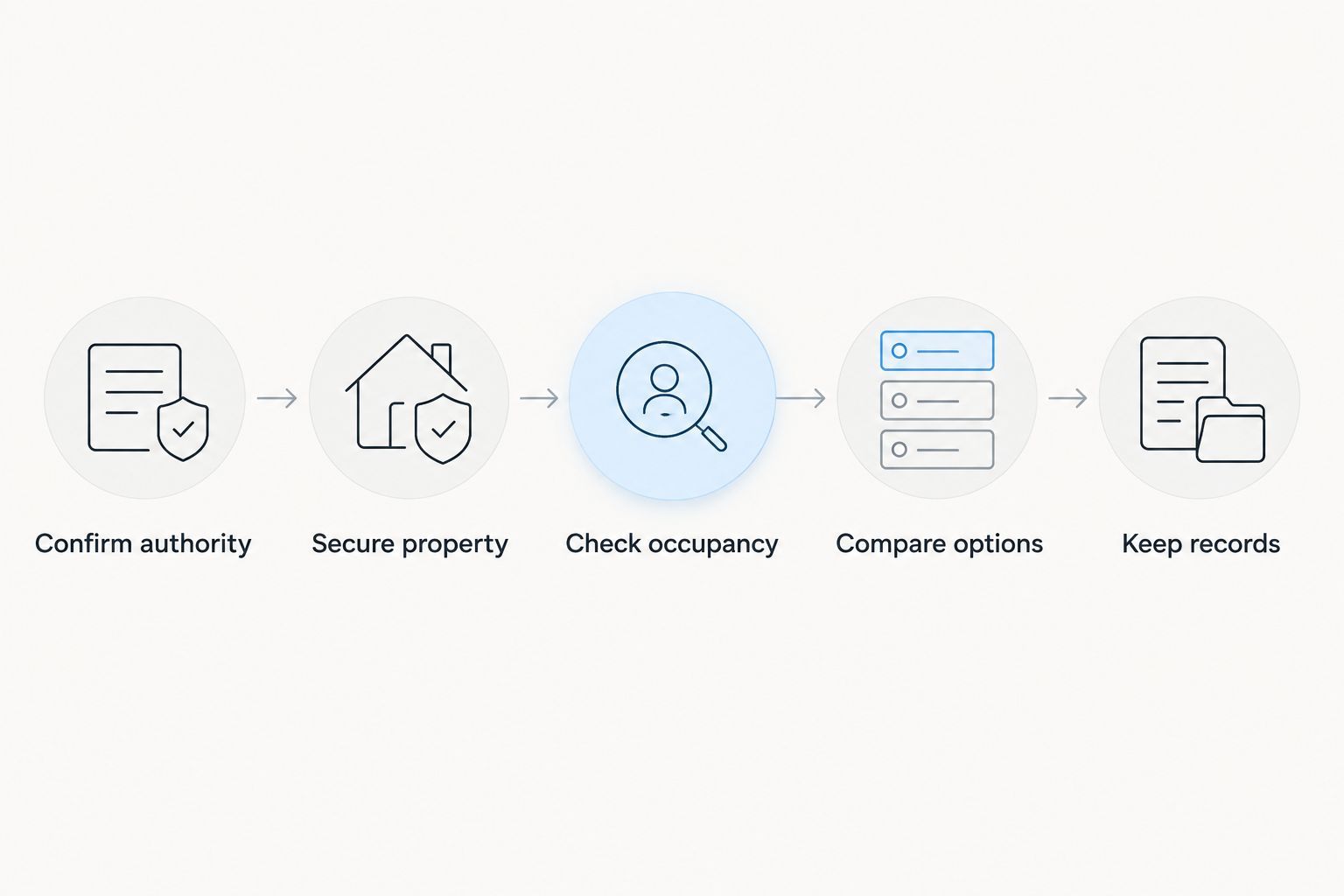
The core sequence is Confirm authority, Secure property, Check occupancy, Compare options, Keep records. Keep those tasks visible even when different professionals handle them.
Compare management options for an estate property
Choose support around the property’s immediate needs. Operational management and estate administration are different services; neither replaces the other.
| Option | Best for | Main benefit | Key limitation |
|---|---|---|---|
| Executor-led coordination | An executor able to attend and organise routine tasks | Direct oversight of documents, contractors and decisions | Requires time and does not replace professional advice |
| Existing managing agent | An already-tenanted property with established records | Continuity of tenant communication and property records | Authority, instructions and the existing agreement still need checking |
| Axiom Realty property management | Executors seeking delegated Adelaide rental management | A local agency offering property management | Estate legal and tax decisions remain outside property management |
| Estate solicitor | Authority, probate and estate administration questions | Advice on the legal basis for decisions | Does not replace daily property inspections or rental operations |
| Accountant | Tax treatment and financial consequences | Advice informed by the estate’s financial circumstances | Does not manage tenants, maintenance or property access |
Choose the role before choosing the provider. If the urgent problem is a leaking pipe, identify the authorised repair process. If the problem is whether you can sign an agreement, start with the solicitor.
Common mistakes executors make
Treating a vacant home as a passive asset
An empty house still needs insurance attention, security and maintenance. Allocate responsibility for inspections and essential services instead of assuming a relative will notice problems. Record attendance and escalate damage promptly.
Letting beneficiaries instruct contractors independently
Conflicting instructions create confusion about scope, access and payment. Establish one authorised contact and document approvals. A beneficiary’s preference for a renovation is not the same as an approved estate expense.
Starting a tenancy before checking the estate’s plan
Rental income is not the only consideration. A new tenancy creates obligations and changes the practical circumstances of a later sale or transfer. Confirm authority, property readiness and the intended strategy before advertising.
Clearing the home before documenting its contents
Separate personal belongings from fixtures, property maintenance and rubbish removal. Ask the solicitor how disputed or valuable items should be handled. Photograph and inventory contents before disposal; do not let a clean-up become an undocumented distribution.
Confusing property advice with tax advice
A sales appraisal estimates a possible market outcome; it does not establish the estate’s tax liability. Obtain accounting advice before relying on assumptions about inherited-property exemptions or deductibility. Keep the advice with the decision record.
FAQ
What should an executor do first with a deceased estate property in Adelaide?
Confirm authority, establish occupancy and contact the insurer before making a sale or rental commitment. Ask the estate’s solicitor which protective actions you can take immediately and which require further documentation.
Can I rent out a deceased estate property before probate?
Do not grant a new tenancy until the estate’s solicitor confirms your authority to do so. The answer depends on the estate’s circumstances, ownership and the proposed action—not simply whether the property is empty.
Does a tenant have to leave when the landlord dies?
The landlord’s death does not automatically end an existing tenancy. Continue lawful tenancy management and obtain advice before issuing notices or changing access arrangements.
Is it better to sell or rent an inherited property?
Choose between selling and renting after comparing authority, estate obligations, holding expenses, property condition and tax consequences. Rental income alone does not establish that retaining the property is the better outcome.
Can a property manager handle the whole deceased estate?
A property manager handles the property tasks covered by the management agreement, not the whole estate administration. Legal authority, beneficiary disputes and tax advice require the appropriate professional.
What records should I keep for an estate property?
Keep ownership documents, insurance correspondence, tenancy records, invoices, approvals, appraisals and dated condition photographs. Record the reason for each significant decision alongside the person who authorised it.
Who can help with Adelaide property management for a deceased estate?
Axiom Realty offers Adelaide property management and property sales services. Confirm the proposed scope and estate documentation requirements, while retaining a solicitor and accountant for legal and tax matters.
One last thing
Decide what must stay before deciding what to remove. Keys, tenancy documents, appliance instructions, repair warranties and records of alterations can be useful long after furniture leaves the house. During a 2026 clean-up, create a property-records folder and keep it separate from personal effects. That small administrative step prevents a clear-out from destroying information the estate still needs.